You don’t need a five-year plan. You just need the next step.
If you’re lying awake replaying the same question, “Is this really it for me?” you’re not alone, and you’re not broken. Career change coaching is a structured process, guided by a career coach, that helps you work through a transition with support: clarify what matters to you, explore realistic options, weigh them carefully, and choose a direction at your own pace. Somewhere between a job that pays the bills and a career that actually fits, a lot of accomplished professionals get stuck not because they lack ambition, but because they lack a clear, low-risk way to explore what else is out there without rushing into the wrong move.
This is for professionals who feel established on paper but uncertain about what comes next, and who want more than generic advice or pressure to have it all figured out right now. Below, you’ll see why career uncertainty can drag on, how coaching creates structure through self-assessment and option evaluation, how to think about transferable skills, money, entrepreneurship, or franchise ownership, and how to turn exploration into practical next steps. When you’re trying to balance stability with the desire for something better, that process can reduce the noise, lower the risk, and make a career change feel possible rather than overwhelming.
Why Career Change Uncertainty Is More Normal Than You Think
Feeling stuck doesn’t mean something is wrong with you. It usually means you’ve outgrown the role, the routine, or the ceiling in front of you.
Uncertainty arises because a career change involves so many moving parts at once: income, identity, timing, and risk. Sound familiar?
- You feel unfulfilled, but can’t name what “fulfilled” would look like
- You’re curious about business or franchise ownership, but have zero interest in jeopardizing your stability
- You know you’re capable of more, but aren’t sure what “more” actually means
None of that is a red flag. It’s the starting point that almost every career changer begins from.
The Real Problem Isn’t Indecision, It’s a Lack of Structure
When there are too many possibilities and no clear process for evaluating them, career exploration can turn into a cycle of overthinking.
One night, you’re browsing job openings. Next, you’re researching business ownership. Then you wonder whether you should simply stay where you are. Without a framework, every possibility can create another question.
Research supports the value of structured career exploration. A 2022 study published in Frontiers in Psychology examined how career stress, career exploration, and future work self relate to career planning and career indecision. The researchers found meaningful relationships among these factors, highlighting the role that exploration and planning can play in the career decision-making process.
You can read the full research on career exploration and career planning.
For adults navigating an evolving labor market, career guidance can also help identify career options, skills gaps, and potential pathways. The OECD describes career guidance as a way to help adults make informed occupational, education, and training choices as work and skill requirements change.
The point isn’t to eliminate every uncertainty before you move forward. It’s to replace an endless loop of “What if?” with a process for asking better questions.
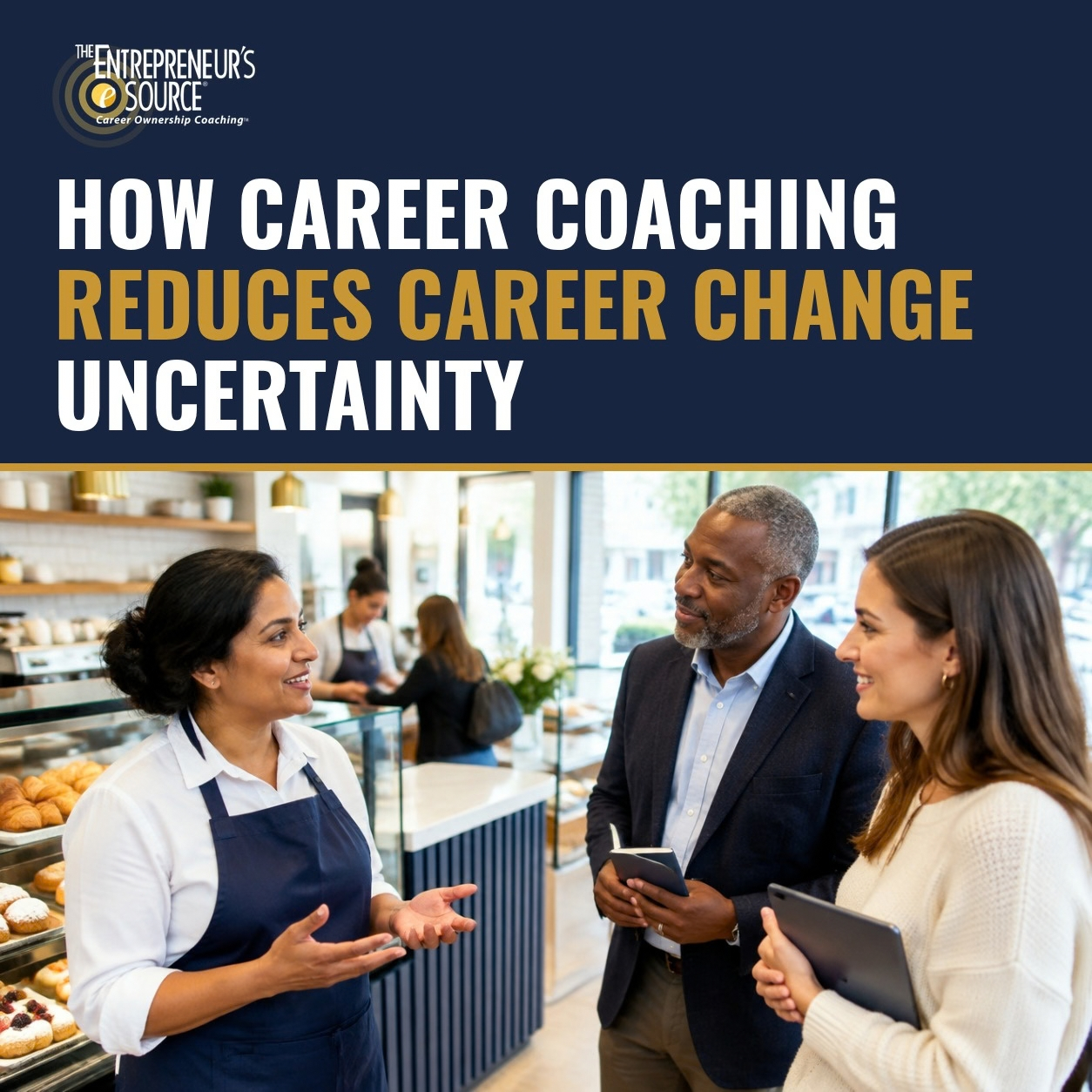
What Working With a Career Coach for Career Transition Coaching Actually Looks Like
This isn’t recruiting, and it isn’t a hard sell toward any single path. A career coach helps you think clearly, not hand you an answer, through structured conversations that typically last 45 to 90 minutes and offer practical advice.
A guided coaching process typically walks through:
- Self-assessment — clarifying your values, strengths, and what “success” needs to feel like for you
- Exploration — surfacing options you may not have considered, from a new corporate role to consulting to business or franchise ownership
- Evaluation — weighing each option against your goals, risk tolerance, and timeline
- Direction — narrowing toward a path that’s genuinely yours, at your own pace
It also includes regular check-ins to track progress and adjust the strategy as you move forward.
No pressure to commit to anything on day one. Just a clearer picture, one conversation at a time, with accountability to help you keep moving between conversations.
Facing the Fear of Making the Wrong Decision
Fear of making the wrong choice is often the challenge that keeps people frozen in a job they’ve already outgrown.
Here’s the reframe: a good coaching process isn’t designed to get you to a decision faster; it’s designed to get you to a decision you actually trust and build confidence in along the way. When you’ve genuinely explored your options instead of guessing, “wrong decision” stops being the threat it once was.
Balancing Financial Stability With What You Actually Want
Let’s be honest, nobody wants to trade a steady paycheck for a leap of faith. That fear is valid, and a responsible coach treats it that way.
This is why career coaching services typically evaluate income goals and lifestyle priorities side by side, rather than income or lifestyle alone. The point isn’t choosing between security and fulfillment. It’s finding where they overlap so you can figure out what support makes sense and align your income goals with the life you want outside work.
Is Entrepreneurship or Franchise Ownership Right for You?
You don’t have to know the answer to that question to start exploring it, and that’s the part most people get wrong.
Business and franchise ownership aren’t all-or-nothing bets. A structured exploration process helps you test the idea against your real skills, interests, and risk comfort before you ever commit a dollar, and for some people, it becomes a useful course correction toward entrepreneurship and business ownership. For some people, the answer is yes. For others, it’s a confident no, and that clarity is just as valuable. Some clients also compare franchises with start-ups as a separate path to ownership before deciding what fits best.
Identifying Transferable Skills You Didn’t Know You Had
Years of experience in management, sales, operations, or client relationships, including roles beyond your current job title, build skills that can open doors in a different industry. A good coach helps you see your background as a toolkit, not a limitation, and helps define how those strengths fit into a new profession or path, building the confidence to consider new opportunities or even business ownership.
Turning Exploration Into a Clear Next Step
Career change doesn’t require certainty on day one. It requires taking the next step toward a new job or role you can actually pursue.
Guided exploration gives you that: a structured way to test ideas, gain an objective perspective, and build clarity, without pressure and without needing to have it all figured out before you begin. It also helps you create a strategy, sharpen focus during a job search, and identify practical next steps.
The Bottom Line on Career Transition Coaching
Uncertainty isn’t a signal to stay stuck. It’s a signal to explore, with the right support in your corner. Career transition coaching exists precisely for this stage, before you know your next move, while you’re still figuring out what is a good fit and whether a path aligns with your goals, not just the fastest option.
If you’re curious about what structured exploration could look like in your own situation, The Entrepreneur’s Source® offers a no-pressure way to start that conversation, one designed to help clients create a career path that makes sense for the person they are and the life they want. If you’re interested, you can talk with the team to see whether the process fits your goals, and the stories they share can help you decide whether it feels like a fit without pushing you toward a decision you’re not ready for.