Most independent startups don’t survive their first decade. That single fact keeps a lot of talented professionals frozen, dreaming about business ownership but terrified of losing it all.
If you’ve spent years climbing the corporate ladder only to feel stuck, underappreciated, or one reorg away from uncertainty, you’ve probably wondered if there’s a safer way to work for yourself. The fear is real: What if I fail? What if I don’t know enough? What if I sink my savings into something that flops?
Here’s the reassuring part. Not all paths to business ownership carry the same risk. Low risk franchise opportunities exist precisely because they remove much of the guesswork that sinks independent ventures. Let’s break down what actually makes a franchise business “low risk” and why that matters for your next chapter.
What does “low risk” really mean in franchising?
“Low risk” doesn’t mean “no risk.” Any investment carries some uncertainty.
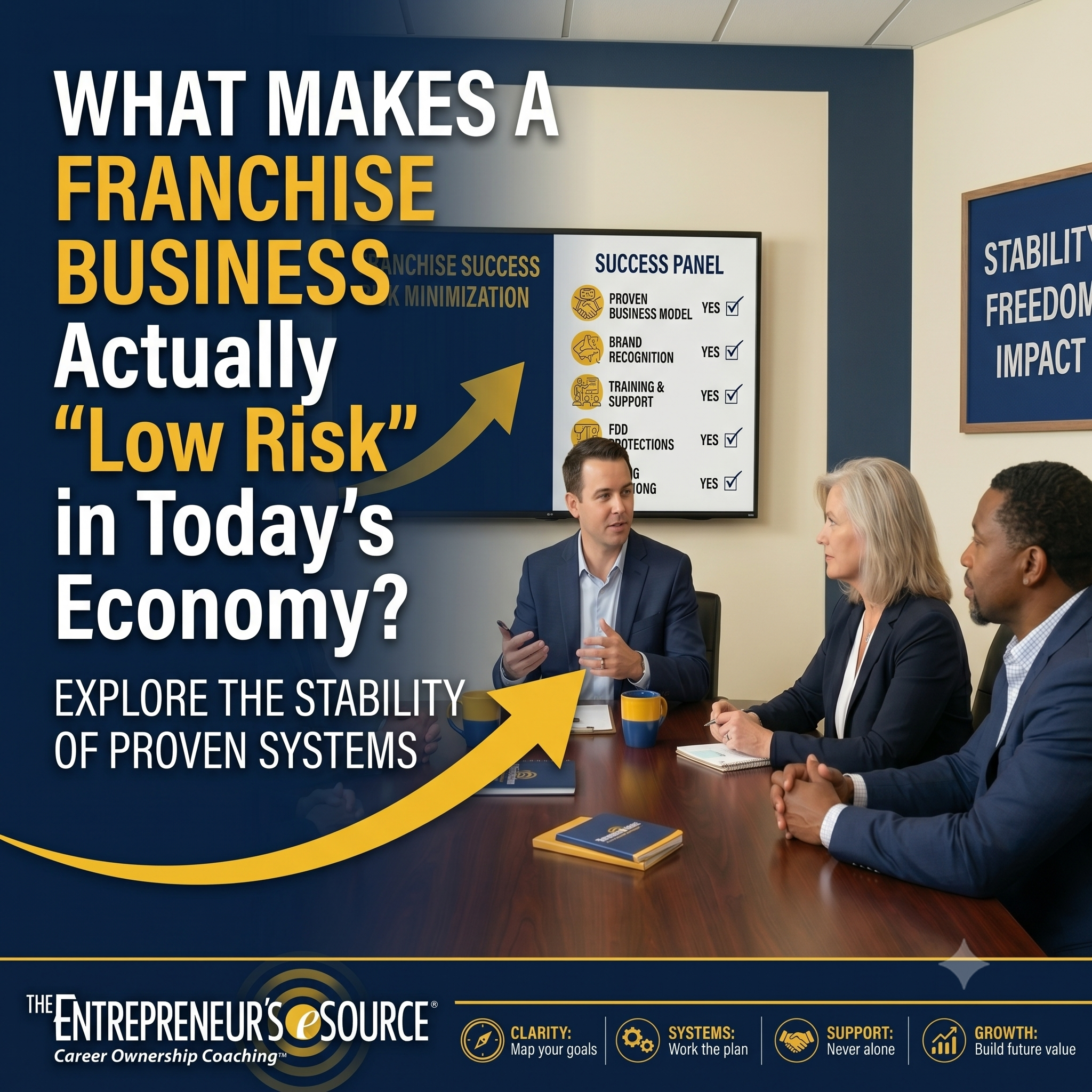
What it means is that a proven business model has already absorbed many of the costly mistakes for you. Instead of inventing systems from scratch, you step into something that’s already been tested, refined, and repeated.
Think of it this way: an independent business owner writes the recipe while cooking. A franchise owner gets the recipe, the ingredients, and a chef on speed dial.
Why a proven business model lowers your risk
The biggest reason low risk franchise opportunities appeal to first-time owners? You’re not guessing.
A franchise business model has been documented, stress-tested, and improved across many locations and many franchise owners. That track record gives you a roadmap instead of a blank page.
The proven business model typically includes:
- Operational systems that tell you how to run day-to-day tasks
- Marketing playbooks that have already worked for other franchisees
- Vendor relationships for the franchisor’s goods and services
- Pricing and financial benchmarks you can measure yourself against
When you remove the trial-and-error, you remove a huge chunk of the financial risk. Sound appealing?
How brand recognition reduces uncertainty
Starting an independent business means starting from zero—zero customers, zero reputation, zero trust.
A franchise gives you instant brand recognition. Customers already know the name, already trust the product or service, and often already plan to spend money there.
That established brand does heavy lifting on day one. You spend less time convincing people you exist and more time serving customers who came looking for you.
What role do training and support play?
Worried you lack business ownership experience? You’re far from alone, and the good news is, you don’t need a business degree to succeed as a franchise owner.
Quality franchisors provide initial training that walks you through every part of the operation. Many also offer ongoing training and support long after you open your doors.
This typically covers:
- How to run the franchise business model effectively
- Hiring, systems, and customer service
- Financial management and working capital planning
- Access to a network of other franchisees who’ve been where you are
That support system is one of the biggest franchise advantages. You’re never figuring it out alone.
Why the franchise disclosure document is your safety net
Here’s an “aha” insight many prospective franchisees miss: franchising is one of the few business models with federal regulation built in to protect you.
Under the Federal Trade Commission’s Franchise Rule, every franchisor must give you a Franchise Disclosure Document (FDD). This document reveals the details you need before signing any franchise agreement.
The disclosure document covers things like:
- Franchise fees, the initial franchise fee, and ongoing costs
- The franchisor’s litigation history and financial stability
- Your contractual obligations under the franchise contract
- What training is provided and what support you can expect
Few independent business opportunities come with this level of transparency. Reviewing the FDD carefully—ideally with help from a franchise attorney or advisor—dramatically lowers your risk.
How financing and lower start-up costs factor in
Not every franchise requires hundreds of thousands of dollars. Low cost franchises exist across many industries, from tax preparation to home services to coaching.
Because franchisors and financial institutions view a proven business model as less risky, financing is often easier to secure than it would be for a brand-new independent concept. Lenders like predictability.
When evaluating any franchise investment, look closely at:
- The initial investment and start-up costs
- Required working capital to cover early months
- Whether the franchisor offers or facilitates financing
- The total cost versus the income potential
For many professionals, lower cost ones make business ownership feel achievable rather than out of reach.
Who are low risk franchise opportunities actually right for?
Franchising isn’t for everyone, and an honest advisor will tell you that.
It tends to suit people who value a proven system over reinventing the wheel, who want training and support rather than total isolation, and who are ready to follow a model while still being their own boss.
Choose a franchise if structure and stability matter more to you than building something entirely original. If you crave full creative control over every decision, an independent business may fit better.
Many mid-career professionals and corporate executives discover that their existing skill sets—leadership, sales, operations, communication—transfer beautifully into franchise ownership. You’re not starting over. You’re redirecting what you already do well.
Frequently asked questions
Are franchises really less risky than independent startups?
Franchises tend to carry lower risk because you adopt a proven business model, an established brand, and ongoing training and support. You skip much of the trial-and-error that challenges independent business owners. Risk still exists, but proven systems reduce many common causes of failure.
What is a Franchise Disclosure Document?
The Franchise Disclosure Document (FDD) is a legal document the Federal Trade Commission requires every franchisor to provide. It details franchise fees, the franchisor’s litigation history, financial stability, your contractual obligations, and the training provided—helping prospective franchisees make informed decisions.
How much money do I need to start a franchise?
It varies widely. Some low cost franchises start in the tens of thousands of dollars, while others require hundreds of thousands. Beyond the initial franchise fee, budget for working capital and start-up costs. Because franchises are seen as lower risk, financing is often easier to obtain.
Do I need business experience to own a franchise?
No. One major franchise advantage is the initial training and ongoing support franchisors provide. Many successful franchise owners came from corporate careers with no prior business ownership experience and relied on the proven system to get started.
How do I know which franchise is right for me?
Start by clarifying your income goals, lifestyle priorities, and the skill sets you bring. Then review the franchise disclosure, compare costs, and talk with other franchisees. Working with a career ownership coach can help you match opportunities to what you truly want.
Finding the right low risk franchise opportunities for you
Here’s the key takeaway: low risk franchise opportunities earn that label through proven business models, established brand recognition, structured training, federal disclosure protections, and accessible financing. Together, those factors can offer far more stability than launching a small business entirely on your own.
That said, “low risk” still depends on choosing the right franchise—one that fits your goals, finances, and lifestyle. The wrong match can feel risky no matter how strong the brand.
This is where guidance helps. A career ownership coach can walk you through your options, clarify what you actually want from business ownership, and help you explore opportunities that align with your income and lifestyle goals—without pressure.
If you’re ready to explore what business ownership could look like for you, connecting with a coach at The Entrepreneur’s Source® may be a worthwhile next step. It’s a no-obligation way to gather information and move forward with confidence.